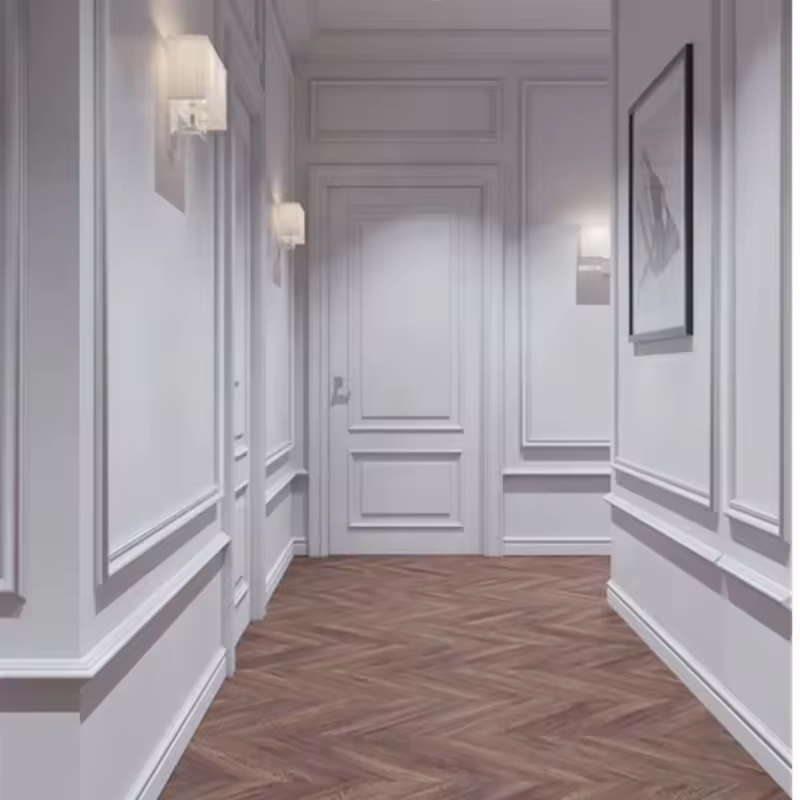
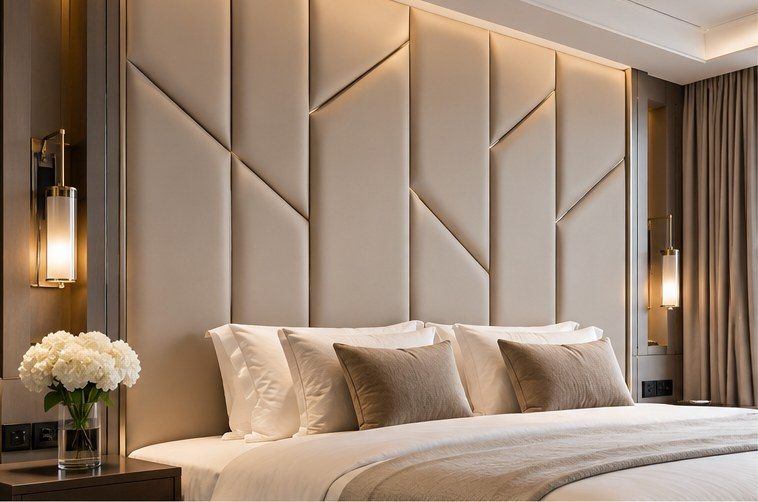
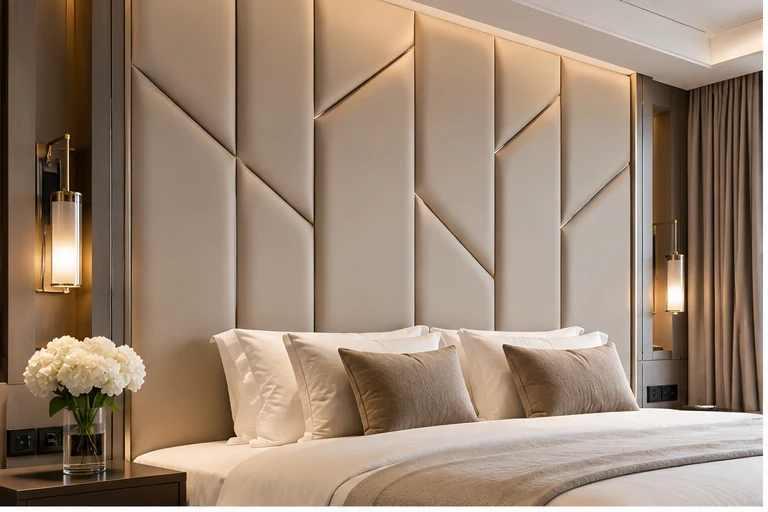
A hotel headboard wall is often designed as one uninterrupted feature, but its delivery depends on dozens or hundreds of repeated parts arriving in the right dimensions. Custom upholstered wall panels can add warmth and texture to guest rooms, lounges and reception spaces. For hotel buyers and interior contractors, the key questions are not limited to color. Upholstery materials, dimensional coordination, cleaning, safety documentation and installation sequence all deserve attention before placing a project order.
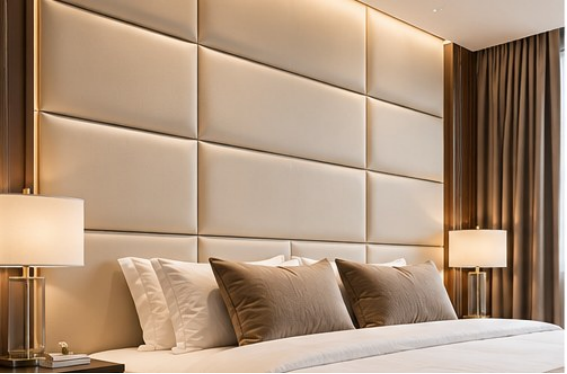
Illustrative design concept – confirm actual product finish with a physical sample.
Start with the room elevation
Send the supplier a dimensioned wall elevation showing bed position, switches, lamps, sockets, furniture and finished floor level. A designer’s rendering might show broad vertical rectangles, but the actual wall contains interruptions. Divide the design into panels that can be transported, handled and replaced without excessive waste. Ask for an approved shop drawing identifying each unique size. When multiple room types are involved, develop one layout code per room type to prevent packing mistakes.
Select fabric or faux leather by maintenance needs
Velvet, suede-look textile and artificial leather produce different appearances and require different care. In a guest room, housekeeping teams need a finish that can be cleaned according to a clear routine. Ask for material swatches, stain-care instructions, seam details and approved cleaning methods. Test how the fabric looks under bedside lighting, because pile direction and surface sheen can change perceived color. Avoid promising that every textile is waterproof or stainproof without supporting product data.
Specify the cushioning and backing
An upholstered panel is a layered component. BOCAS describes options using artificial leather or fabric, sponge cushioning and backings such as PVC foam board or MDF on its product page. The chosen construction influences weight, rigidity and attachment options. Ask for a cross-section sample and finished thickness including any seams. The edge shape should also be approved: a tightly wrapped rectangular edge looks quite different from a rounded, deeply padded style.
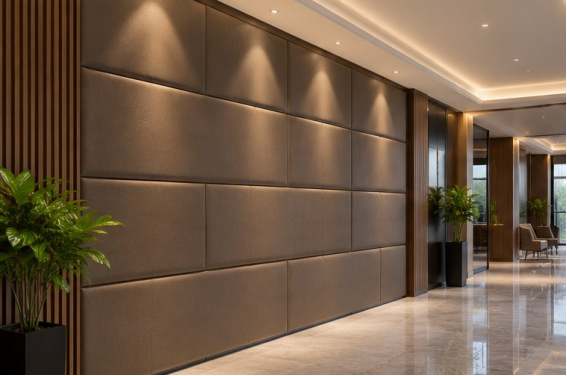
Illustrative interior or material reference; not a photograph of a BOCAS project.
Check commercial project requirements early
Hotel projects may specify reaction-to-fire performance, emissions, durability, cleaning standards or other requirements. These depend on destination and building use. Request test reports for the exact proposed assembly and confirm their relevance with the project team. A general statement that the foam is “fireproof” should not replace technical evidence. Acoustic absorption claims also require appropriate tests if numerical values will be used in specifications. Early document review prevents redesign after procurement.
The mock-up is the real approval step
Before a hotel-wide rollout, install one full-size sample bay or guest-room wall. Review the arrangement under real lighting and let the housekeeping or facilities team test the proposed cleaning method. Take measurements from the completed mock-up and record any required corrections. The supplier should not treat a rendering alone as final approval. A successful mock-up reduces the risk of repeating a wrong seam line or edge shape across hundreds of rooms.
Plan installation and replacement
Ask whether the installation method is adhesive, mechanical or a combination and how it interacts with the wall substrate. A concealed fixing system may be helpful when future panels need replacement, but it must be designed in advance. Make a sample wall section including corners, skirting and switches. For a large hotel, a room-by-room packing list can significantly reduce installation confusion. Include a few agreed spare panels from the same production batch to handle later maintenance.
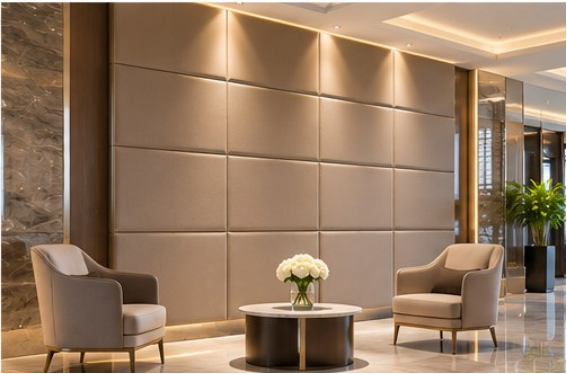
Illustrative interior or material reference; not a photograph of a BOCAS project.
Coordinate delivery with the construction schedule
Hotel wall panels often arrive during a narrow fit-out period, after electrical work and before final furniture placement. Agree the packaging sequence and expected delivery stages early. The receiving team should be able to identify each room group without opening every carton. Ask the supplier to provide an itemized packing list, labels and a drawing reference. If the project is divided into phases, approve one production master sample for the entire scope and discuss how later batches will be matched. This reduces inconsistent finishes between floors.
Price the complete project scope
A project quote should reflect drawings, unique sizes, fabric choice, construction, labels, packaging, transport and spares. Ask about mock-up approval and whether subsequent production will follow a signed reference sample. BOCAS offers customized upholstered wall panel options; request confirmation of the exact manufacturing and customization scope for your project. A procurement decision is stronger when the supplier can answer practical layout and packaging questions, not only quote a price per square meter.
Frequently Asked Questions
What drawings are needed for hotel panels? A wall elevation with dimensions, outlet positions, room types and proposed panel joints.
Can upholstered panels improve acoustics? Soft finishes can influence sound in a space, but performance ratings must come from product-specific testing.
How should a multi-room order be packed? Label cartons by room type, wall code and panel position, with a matching packing schedule.
Request Samples and a Quotation
For the next step, review BOCAS’s relevant product information at https://www.bocasrb.com/product/customized-upholstered-wall-panel-for-hotel-headboard/ and send your intended application, preferred specifications and estimated order volume. Ask for current samples, documented performance information where required, and a quotation that clearly states what is included. A well-defined sample and a transparent specification remain the most reliable starting points for an international wall panel order.